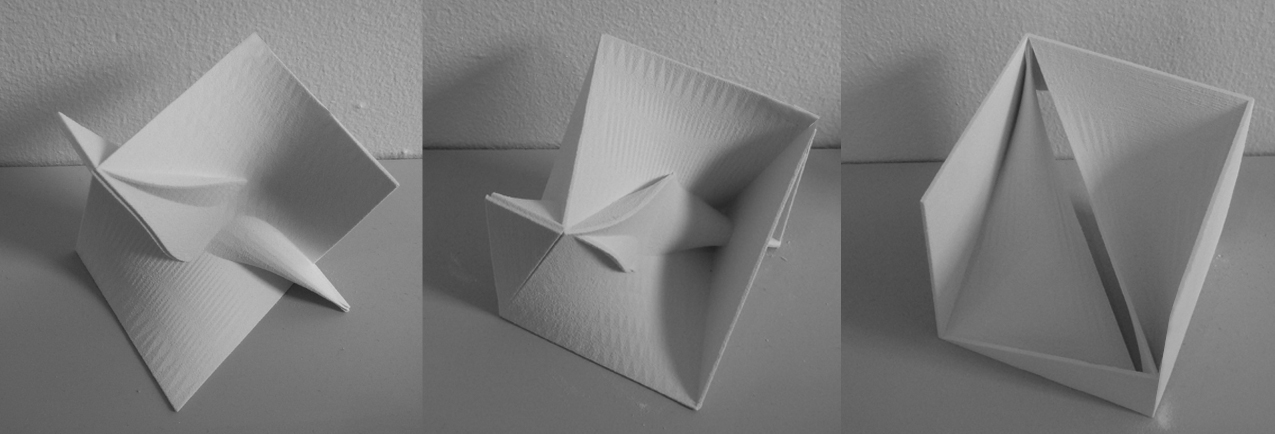
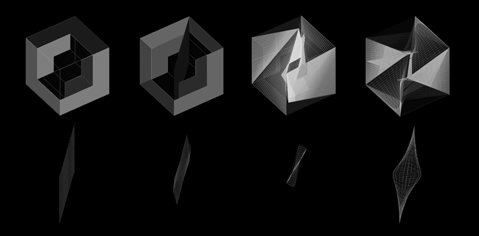
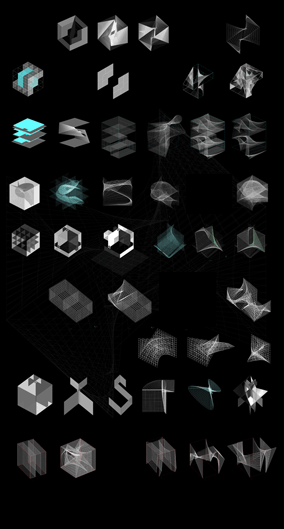
structure and instability: Cartesian absolute structures and topological relative displacements, topological cube


video plays in internet explorer 6.0 or higher


ARCH 177, Cooper Union, Professor Pablo Lorenzo-Eiroa, Students Board ARCH 177 Spring 2009

ARCH 177 COMPUTER GRAPHICS, IMAGE PROCESSING AND VISION

Structure and Instability: Simulation Laboratory

Professor Pablo Lorenzo-Eiroa 

This course revisits the contemporary potential for an architecture autonomy through the reconsideration of canonical structures to find a strategy to redefine post-structuralism as a continuity of structuralism. The testing of the structuralist strategies of Wittkower’s Palladian Villas diagrams, Rowe’s Palladio-Le Corbusier diagram, Hejduk’s Texas Houses and Eisenman’s Houses series in relation to contemporary post-structuralist canons, may provide an axis of reference to revise a more critical role of deconstruction avoiding its current iconographic tergiversation.  

As a laboratory, we experimented with a vectorial nine square grid structure and dealt with surface as a “ground” through analog and digital computer assisted architectural constructions and transformations. This content-oriented workshop’s intention is meant to critically relate the autonomy of architecture to the virtual space of the computer, through specific software strategies. Alternative processes of instability, that brought about contemporary architecture canons and resulted in an expansion of the discipline, were studied to inform space by affecting the structure of this organization by enfolding these canons back as a contraction. Surface writing and parametric design as algorithms relied both on analog and digital strategies between sketches, Photoshop, AutoCAD, MathCAD, Rhino and MAYA software. The exercise was presented with an animated digital simulation that reworked time-based sequential diagrams that indexed and edited its constitutional process. 

The reactionary process of post-structuralism has been negating any reference to more stable canonical structures, but also more recently, has been also negating the mediation of computer interfaces that striate the work. The intention is to work these interfaces avoiding the semiotics of the image that computer representation constantly forces, that may only develop shapes rather than structurally index the constitution of form. Attacking the stability of these given frame-structures, the seminar searches for gradual architectural transformations deep enough to alter the given structure and therefore critiquing the departure point. The working of the intermediation of the relationship between the architecture student and the virtual space generated out of the numeric binary and then vectorial translation into images that computer interfaces develop, constitutes a series of problematic interface-frames. Rather than working with the output of images, the idea is to work through a possible digital affect as projects develop abstract spatial relationships that displace the representation of inhabitation. As computer displaces multiple representational structures and their tectonics, this seminar touches upon multiple issues attempting to understand the logics of these displacements and integrating their mediation as part of the development of an autonomy of the work.  

This exercise departs from a reduced architectural condition within a generic nine square grid structure, to then induce transformations to this organization. Students develop a series of diagrams to analyze and develop alternative possible problems implicit in the relationships that these organizations acquire and possible further displacements to achieve other consequential spatial transformations that would overcome the original given type.

 Two aspects of the contemporary displacement of the tectonics of the surface were part of the initial assumption in relation to the current expansion of the discipline. First, the dissembling of the object towards the expanded field condition was resolved in the thickening of the ground as an inhabitable surface, which became one of the primary contemporary architecture canons. The surface became the interface by which architecture shifted the tectonics of the wall surface for the tectonics of the ground surface, from a generic vertical condition to a striated field of layers and finally to the horizontal-topological, as topo-logos or the specific logic of the place. Second, as part of this process of expansion of the discipline, the paradigmatic mathematical möbius strip surface was an external model that became an architectural canon referencing spatial warping and continuity. This model transformed the architecture envelope and its interior-exterior relationship as well as the substitution of Cartesian space for a mathematical topologically-based space, a space of bi-continuous deformation.

The use of the vectorial surface is understood as analogous to both of these tectonics. In order to enfold these canonical processes and confront them with more stable historical structures, the mathematical writing of this surface is understood as a strategy to inform topological displacement to the original Cartesian nine square grid organization. As external to the field, mathematical parameterization of geometry, parametric surfaces were developed inducing the study of spatial warping. This surface is partially developed using this mathematical logic, inferring an external model, but also accumulating a series of analogically produced transformations. Informational binary numeric control parameterization of mathematically striated computer language and, as a consequence its visual translation as space, is confronted through parametric design that forces the formal disjunction between information and its visual translation. The exercise tangentially develops a strategy that forces students to confront this informational logic departing from given paradigmatic mathematical expression types, such as a möbius surface as a mathematical expression, that are transformed to achieve a particular configuration that is used to inform indirectly space. This interface surface-matrix functions as a program in which transformations are accumulated in a layered process that is alternative to the classical relationships between part and whole. This conforms a visually driven analogically produced architecture based algorithm which informs space indirectly and that resists the automatic array of non-critical solutions of the computer logos.

Since these contemporary reactionary canons are enfolded back against more stable architecture canons and departing structures, these processes of instability intend to suspend the dialect structuralism against post-structuralism and present an alternative to the current state of expansion of the discipline, constructing an autonomy that emerges out of these conflicts.

The School of Architecture of The Cooper Union ARCH 177 Students:

ahn catherine
binder daphne
brostrom lina
chong jaeho
chou chia
chybireva anastasiya
clapham tanner
cortes dionisio
foster christian
hayatsu jun
heyman malin
huber david
kang seung-hyun
levine raye
pounds christopher
saether laura
stulc alexan
vega rolando
wills daniel
wood alexander
yamamoto kinu